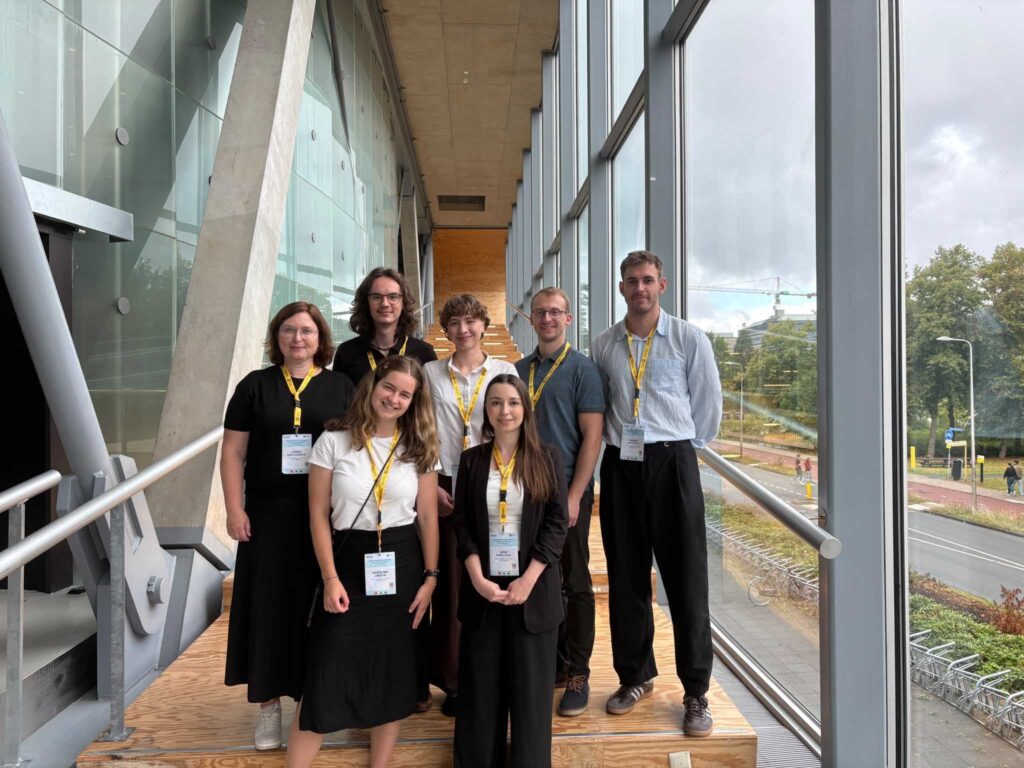
From August 18–21, 2026, the 20th Conference of the European Association for Research on Adolescence (EARA 2026) was held in Utrecht, with the theme Dynamics of Youth. Our laboratory presented seven oral presentations at the conference. With this number of presentations, we made a significant contribution to the strong representation of Czech research in this year’s program.

Naše prezentace
Wednesday 19.8
We kicked off the program on Wednesday with a presentation by Tereza Levková (Can sleep signal social trouble? Dynamic interplay between sleep and peer status), which uses eight weeks of data from Fitbit watches and weekly sociometric nominations to examine the short-term dynamics between peer victimization and sleep among high school students and asks whether sleep can serve as an early warning sign of emerging victimization. In the afternoon, Aleš Přibík (Reciprocal effects between school belonging and positive affect: KiVa intervention) examined whether school belonging and positive affect influence each other even at the level of changes in individual students and whether this relationship differs between regular schools and schools participating in the KiVa program.
Thursday 20.8.
Thursday was dedicated to bullying and victim defending. The head of the Department of Personality and Social Psychology Lenka Kollerová (Social goals, norms, and support in defending across the school year), demonstrated that peer normative pressure moderates how students’ social goals translate into standing up for victims, and that these processes change over the course of the school year. Later that morning, Karolína Umová (Stress & self-harming ideation) examined self-blaming attributions and emotional self-efficacy as moderators of the relationship between accumulated stress and subsequent emotional experiences following the transition to high school.
Na to navázala Jana Fikrlová (Transitions among subgroups of bullying participant behaviours in Czech adolescentsidentified three subgroups—non-participants, victim-defenders, and bully-victim-defenders—based on a sample of 1,996 adolescents, noting that the highest-risk subgroup was also the least stable. In the same session, Adam Klocek presented the YoungLink tool (Seeing the classroom through many eyes) for digitally mapping peer relationships, power dynamics, and bullying in classrooms; based on data from numerous classrooms, the tool is designed to provide rapid feedback to prevention specialists.
Friday 21.8.
We concluded the conference on Friday with a presentation by Radek Rychlík (Beyond objective integration: how belonging shapes norm perception in peer networks). He distinguishes between a subjective sense of belonging and an objective position within a class network, thereby paving the way for identifying “hidden vulnerable” students, whose exclusion often goes unnoticed.
Prezentace labu SATIS
Researchers from the SATIS lab, with whom we collaborate closely, also presented their findings in Utrecht. Tomáš Lintner (Does peer exclusion predict seclusion into generative AI among adolescents?) examined whether adolescents who are excluded are more likely to seek help from AI. Another presentation by Markéta Žáková and Veronika Tesařová (Academic motivation in adolescent peer networks: the role of teacher support) used network models to analyze the interrelationships between declines in academic motivation, socioeconomic status, and friendships.